
Nevada S.A.V.E. Replaced VINELink
Nevada replaced its VINE service with S.A.V.E. in August 2025. The current one-person workflow therefore does not begin on VINELink. It begins by finding the specific offender in S.A.V.E., comparing available identifiers, and attaching a registration to that person. Registrations can continue across later incidents and transfers among participating Nevada criminal-justice custody or supervision agencies. That person-based design can remain useful after a name disappears from a current jail display.
Churchill County's detention page still contains legacy Nevada VINE language. It is a stale channel, not proof that old registration steps remain active. People who once relied on the VINE mobile app were told to register again in S.A.V.E. A saved VINE PIN does not migrate the old registration. The present task is to establish or confirm a S.A.V.E. account and select the correct offender.
S.A.V.E. is free and available in English and Spanish. Nevada provides telephone help around the clock. Registration can be anonymous, and NDOC states that a name and other personally identifying information are not required. Users may select telephone, email, or text options that the portal offers. Blackout dates and off-hours can be chosen, but a release notice is sent at once even during a blackout period.
The official legacy VINE page supplies the historical view below.
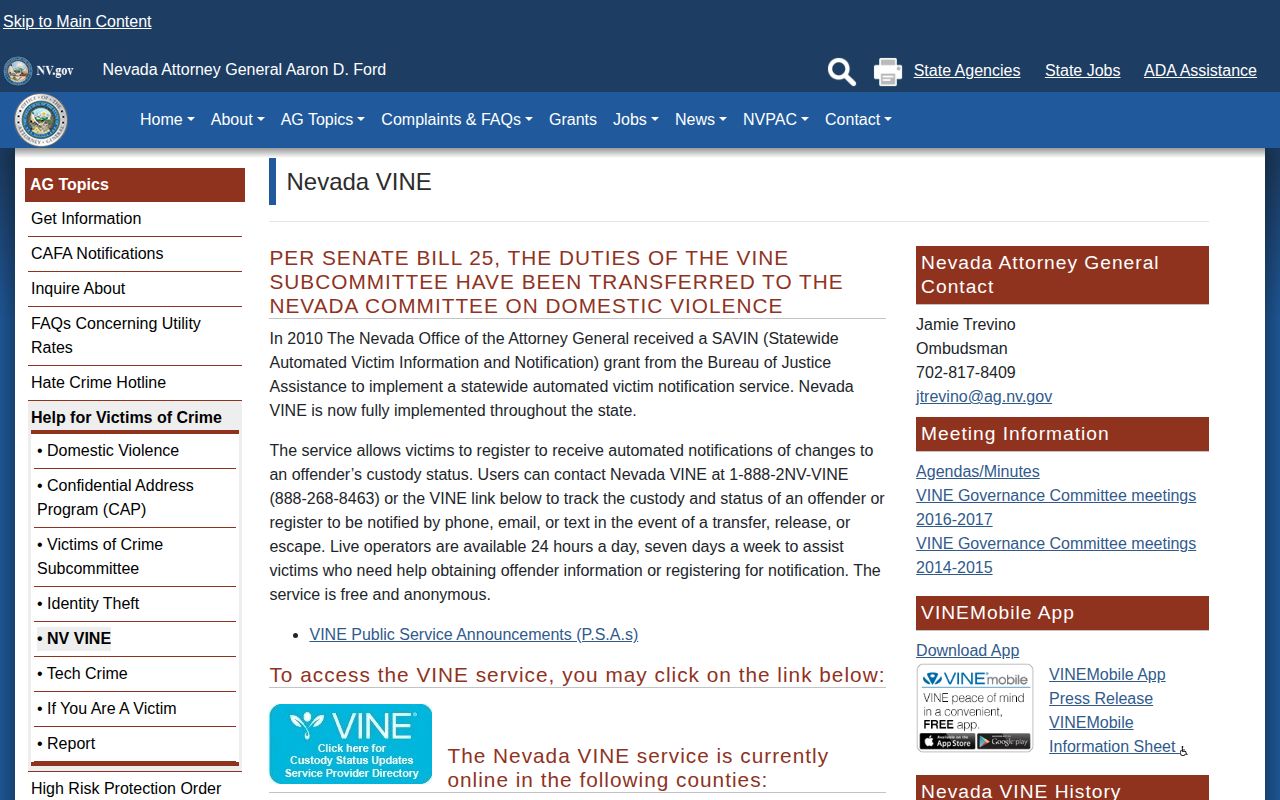
Search a Churchill County Offender
A specific-person search should begin with enough detail to prevent a false match. Full name is useful, but similar names, aliases, and spelling variants can point to the wrong record. An offender or booking identifier is stronger. Compare all identifiers the current result supplies. If the person left the Churchill County jail for NDOC, the state Offender ID and sentence information help connect the county event to the state record.
- Open save.nv.gov and use the specific-offender search.
- Enter the known name or identifier. Try a verified alias or spelling only when the first search fails.
- Compare the available identity details before selecting a record. Do not rely on a shared name alone.
- Read the exact status, event type, agency, and time shown. Preserve a copy of the alert or result.
- If the event says release, identify which agency reported it. If it says transfer, locate the receiving custodian.
- Confirm the event through the Churchill County jail, NDOC, NPP, or court responsible for it.
S.A.V.E. is not the broad released-person search for every possible custody system. Federal Bureau of Prisons custody is checked through the BOP locator. ICE custody requires the ICE locator when case facts support that possibility. Juvenile information from Teurman Hall is confidential and is not an adult S.A.V.E. search path. A parent, guardian, attorney, or other authorized person must work with Juvenile Probation, Teurman Hall, and the court.
For a jail-only booking, the Churchill County release or transfer record remains the best source for the actual end time, release reason, and destination. For a state sentence, NDOC publishes a release dataset with Offender ID, booking ID, release date, and release description. The Churchill County released-inmate process links those agency-specific records into a full verification path.
Churchill County S.A.V.E. Event Fields
Custody notifications are event reports. Their meaning depends on the words used. “Release” can indicate that the reporting custody episode ended. It does not always mean that every form of custody or supervision ended. “Transfer” means that responsibility changed hands. A parole or supervision event can place the person outside a prison while legal restrictions continue. Preserve the service's wording rather than replacing it with a broader conclusion.
| Information | What it can establish | What still needs confirmation |
|---|---|---|
| Offender identity | The record selected for monitoring | Match with stable identifiers and agency record |
| Reporting agency | The Nevada participant that sent the event | Whether another agency took custody next |
| Custody status | The status transmitted at that point | Official current status from the custodian |
| Release event | A reported end or change in custody | Release type, exact official time, and destination |
| Transfer event | Movement between custodians | The receiving facility and current custody |
| Notification time | When the service sent an alert | Whether it equals the jail-door event time |
NDOC cautions that S.A.V.E. information is transmitted by participating agencies, is not audited before transmission, and is not an official NDOC record. A lag, correction, or mismatch is possible. An alert is a strong prompt to check, not a certified release record. If exact timing matters, ask the responsible custodian for the existing release, discharge, or transfer record.
Register Churchill County Release Alerts
Registration should attach to the verified person, not merely a similar name. Nevada's current service supports several contact methods and lets a registrant manage notification timing. Keep account access current. A changed phone number or abandoned email address can defeat the alert even when the custody event is transmitted correctly.
- Visit Nevada S.A.V.E. and select Create Account, or call 1-866-393-5445 for 24-hour help.
- Locate the intended offender and verify the available identifiers before attaching the registration.
- Select telephone, email, and text notices as the service offers them. Choose more than one useful route when practical.
- Use anonymous registration if desired. Nevada says personally identifying registration details are not required.
- Set blackout dates or off-hours if useful. Remember that a release notification is still sent immediately.
- Save the registration confirmation and test access to the account. Update contact details when they change.
- When an alert arrives, record its exact words and time, then contact the agency that reported the event.
No four-digit PIN is part of these current steps. That PIN belonged to the former telephone VINE system. Presenting it as a S.A.V.E. requirement could leave someone relying on an inactive registration. The old workflow is relevant only when interpreting a historic brochure, call log, screenshot, or prior registration.
The Nevada registry notification page is the source for this separate program view.
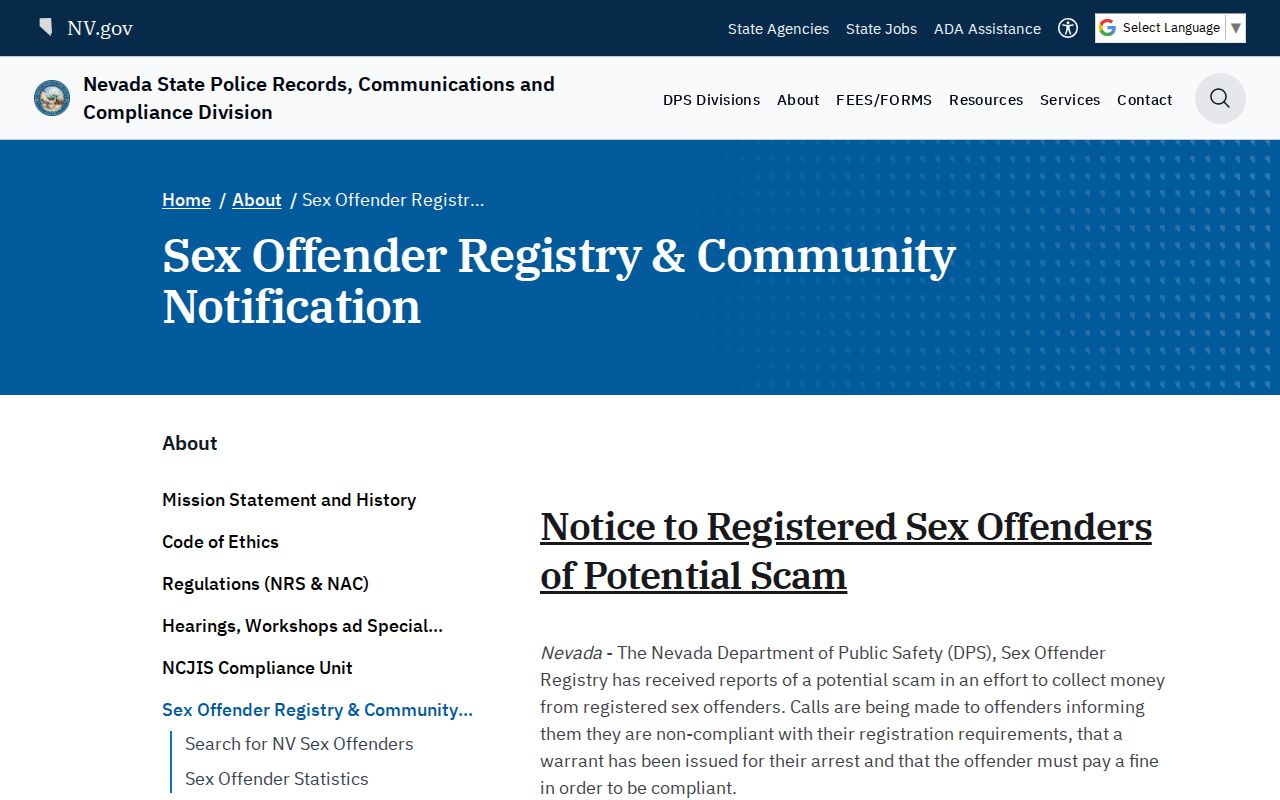
Legacy VINELink PIN History
Before August 2025, Nevada VINE users could search by offender name or offender number and register telephone numbers or email addresses for release, transfer, escape, and death notices. Telephone registration required a four-digit personal identification number. When VINE called, entering that PIN followed by the pound key acknowledged receipt and stopped repeat calls. If nobody answered, the system could leave a message and continue calling for up to 48 hours or until the PIN was entered. Email registration did not use a PIN.
The former brochure said registrations were confidential and the offender was not informed. A round-the-clock operator could help reset a forgotten PIN or cancel a registration. Those facts can explain older records. They are not current instructions. Nevada specifically required former VINE mobile-app registrants to re-register in S.A.V.E. after the transition.
- Legacy VINE
- Nevada's former notification service, discontinued in August 2025.
- VINE PIN
- A historic four-digit telephone acknowledgment code, not a S.A.V.E. credential.
- S.A.V.E.
- Nevada's current offender-based custody and supervision notification service.
- Transfer
- A change of custodian that does not establish return to the community.
- Release alert
- A transmitted event that should be confirmed with the reporting agency.
The Churchill County detention website still displaying old VINE text creates a local stale-channel risk. The county page may be useful for facility contact details, but its VINE instructions should not override the statewide transition notice or current S.A.V.E. portal. When two official pages disagree because one has not been updated, follow the current statewide system and note the date of each source.
Confirm Churchill County Release Events
Confirmation depends on the event's source. For a Churchill County Detention Center event, call detention at (775) 423-1596 or request the specific booking release or transfer record. Ask for the actual date and time, recorded disposition or release code, and receiving agency when the event was a transfer. A court docket can explain the order behind the event, yet the order time may differ from the moment jail processing ended.
For an NDOC event, match the Offender ID and booking ID in the agency's release data, then read release_date with release_desc. More than one release row may be valid when the person had multiple sentences, parole episodes, returns, or releases. An agency location of PAROLE suggests community supervision, while an inactive discharged or released value points toward a closed episode. NDOC's raw-data warning still makes a formal record the best final proof.
For parole or probation, contact the Nevada State Police Parole and Probation field office serving Churchill County. A supervision event is not final discharge. For federal imprisonment, use the Federal Bureau of Prisons locator. For a possible ICE handoff, use the ICE locator and the county transfer record. Neither federal system is covered merely because a Nevada S.A.V.E. search returns no result.
- Preserve the alert exactly as received.
- Identify the agency that reported it.
- Distinguish release, transfer, parole, and discharge.
- Obtain the underlying agency record when timing or destination matters.
- Recheck status if the result conflicts with known court or custody facts.
A missing result also needs restraint. It can reflect a spelling problem, different identifier, sealed information, a system outside Nevada S.A.V.E., or a delay. It does not prove that a person was never held or has been released. The strongest conclusion combines the notification with the agency record that created the custody event.