
Churchill County Projected Release Dates
A projected date is a calculated milestone based on facts known at the time. An actual date records what happened after release processing was completed. They can differ. Sentence credits may change, a court may amend the judgment, another sentence may be aggregated, a detainer may prevent community release, or parole may be granted or denied. For that reason, a future date should be written down with its source and the day it was checked.
The Churchill County Detention Center mainly houses pretrial detainees. Their cases turn on court action rather than a prison sentence calculator. A person may bond out, receive own-recognizance release, remain held pending a hearing, or transfer to another custodian. A transfer ends the local jail stay but is not release to the community. For a sentenced state prisoner, NDOC is the relevant source. For a county sentence, the jail record and court judgment must be read together.
| Custody status | Best date source | What the date means |
|---|---|---|
| Pretrial at county jail | Court order and jail status | No fixed end date until legal authority and processing align |
| County sentence | Judgment plus jail computation | Expected end after applicable credit and orders |
| Nevada state prison | NDOC record and sentence data | Calculated milestone, not proof of release |
| Released from NDOC | NDOC release event | Actual recorded date and description |
Find a Churchill County Release Date
Start by identifying the last custodian. The Churchill County jail cannot compute a state-prison date, and NDOC may have no record for a person who only had a local booking. Use an Offender ID when it is known. Name searches need care because aliases and similar names can produce a false match. Compare age, physical description, sentencing county, offense details, and sentence information before relying on the result.
- Check the current custody source. For a local booking, use the sheriff's inmate function or contact detention. For a state sentence, open the NDOC Offender Search.
- Match identity by Offender ID or by name plus several other details. A percent sign works as a wildcard in NDOC name fields.
- For county custody, obtain the court judgment or current order, then ask detention for the recorded or calculated release status.
- For state custody, read the human-readable detail record and preserve the exact date label. Do not expand an unexplained abbreviation.
- Compare the booking and sentence data with the release download. A future milestone differs from
release_dateplusrelease_desc. - Check parole actions, detainers, later sentences, or court changes that could alter the result.
- Request an official sentence-computation or release record when precision is required for a court or records matter.
NDOC calls its search information raw data, warns that it may contain errors, and says it should not be used as an official record. Family Services answers inmate-data questions at (775) 977-5707. NDOC Offender Records lists omdrecords@doc.nv.gov, while formal public requests can be sent through the agency's records process. The Churchill County released-inmate record path explains how to request a local release or transfer record.
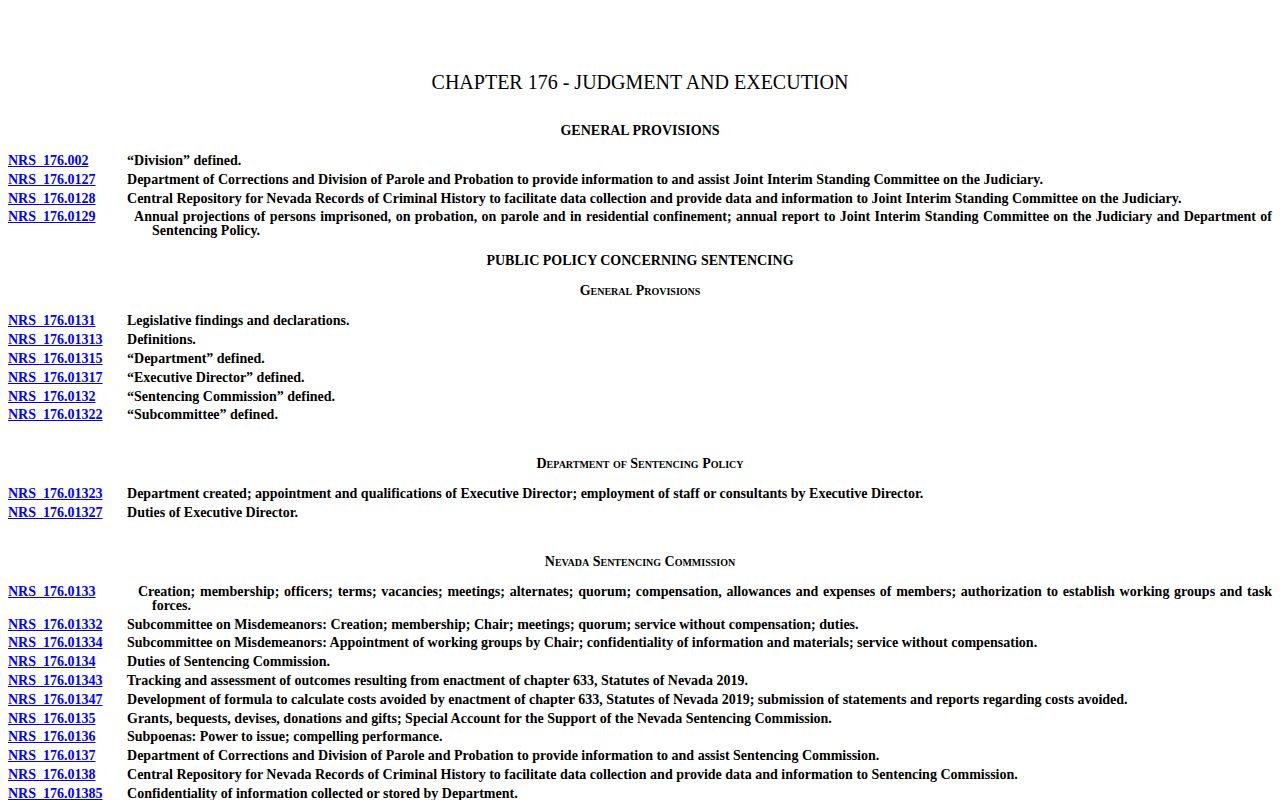
The official Nevada sentencing statute supplies the minimum-and-maximum-term view below.
Nevada Rejects a Blanket 85 Percent
Nevada did not adopt a universal rule that every prisoner serves 85 percent of a sentence. The official legislative history says lawmakers considered that model and rejected it. The 1995 reform instead established a minimum-and-maximum structure. Current NRS 176.033 generally requires a felony judgment to state both terms unless the offense statute calls for a definite term. The minimum period, maximum period, offense date, governing statute, presentence credit, and later corrections events all affect the time line.
This distinction is crucial for a Churchill County inmate release date. Multiplying a sentence by 85 percent can yield a confident but unsupported answer. Even the ratio between the minimum and maximum terms is not a release promise. The minimum can relate to parole eligibility, while the maximum marks another sentence boundary. A Parole Board decision, sentence aggregation, and statutory exclusions may control whether or when an eligible person leaves prison.
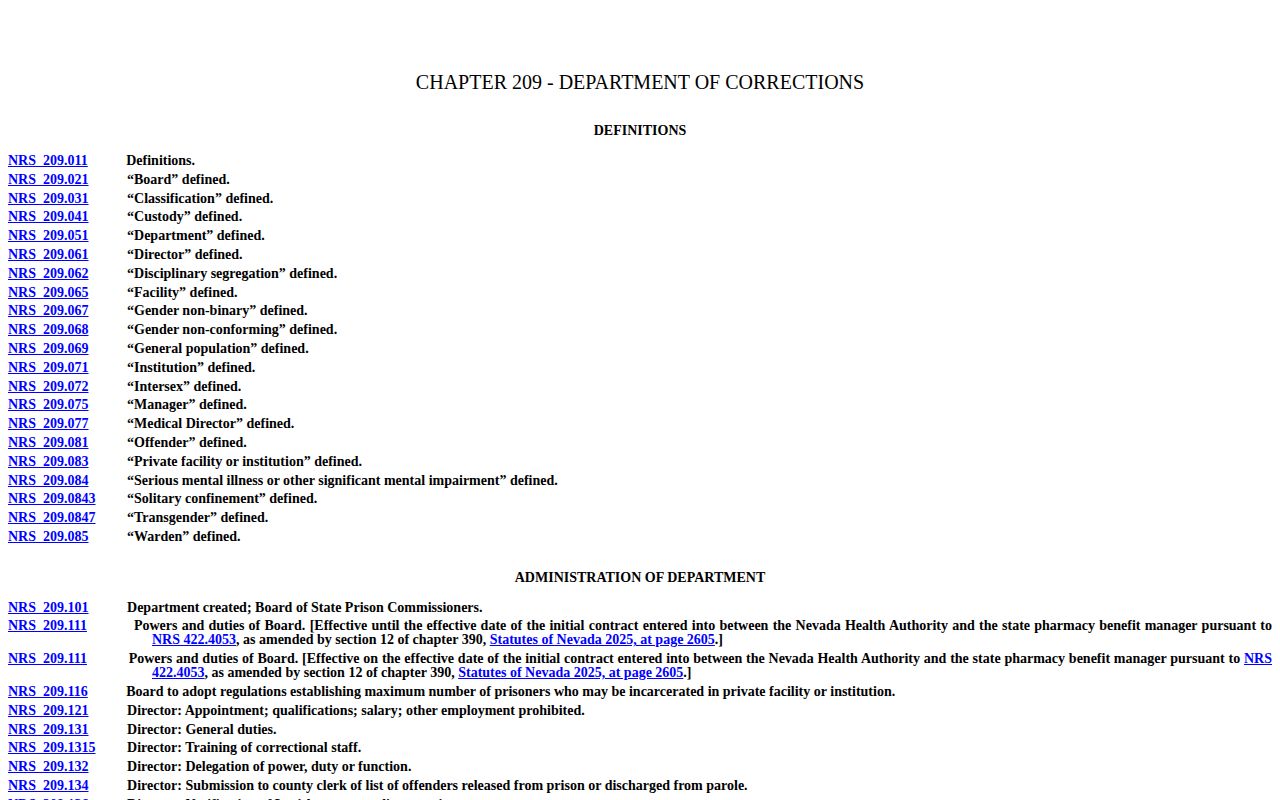
Nevada's current credit framework is in NRS 209.4465. Under the version effective through June 30, 2027, an eligible offender who has no serious infraction and performs assigned duties faithfully, orderly, and peaceably generally receives 20 days of deduction for each month actually served in incarceration, residential confinement, or specified NPP custody. The Director may allow up to ten extra days per month for diligence in labor and study. Educational achievements can support other credits.
Credits generally reduce the maximum term and may apply to parole eligibility, but statutory limits matter. The more favorable minimum-term treatment excludes several groups, including category A or B felonies, felony offenses involving force or threatened force, felony sexual offenses, specified felony driving-under-the-influence offenses, and other listed crimes. The offense statute and date must be checked rather than assuming all people earn the same credit in the same way.
The official Nevada sentence-credit law is the source for the captured rules view.
Churchill County Date Change Factors
A projected date is recalculated when one of its inputs changes. Some changes move a date earlier. Others move it later or prevent a person from entering the community on the expected day. The source record should state whether the date concerns parole eligibility, a projected expiration, a mandatory milestone, or an actual release. Those labels are not interchangeable.
| Factor | Possible effect | Best confirmation |
|---|---|---|
| Presentence jail credit | Changes credited time against a sentence | Judgment and sentence computation |
| Good-time or achievement credit | May reduce an eligible term or milestone | NDOC computation under applicable statute |
| Disciplinary forfeiture or restoration | Can move the calculated date later or earlier | Current NDOC computation record |
| Additional or aggregated sentence | Can extend or restructure the time line | Judgments and booking/sentence data |
| Parole grant or denial | Can authorize release to supervision or delay it | Board action plus NDOC release event |
| Detainer or outside hold | May cause transfer instead of community release | Custodian and receiving-agency records |
| Amended court order | Can change sentence terms or release authority | Filed court order and custodian confirmation |
A detainer deserves special attention. It signals that another authority may take custody when the current basis for confinement ends. The first agency can record a release or transfer while the person remains confined elsewhere. Likewise, parole means release from the institution but continued legal supervision. The actual destination or release description is needed before telling family members that someone has returned to the community.
NDOC Date Labels Need Mapping
NDOC's downloadable booking and sentence data expose unusually detailed yet terse fields. They include sent_ped, sent_mpr, sent_pexd, and sent_rrd, along with minimum and maximum years, months, and days. No official public glossary was located that safely expands every abbreviation. It would be inaccurate to declare that any one abbreviated field is always the projected release date.
Preserve those raw labels when comparing downloads. Then capture the human-readable label on the person's detail screen and connect it through the same Offender ID and booking ID. NDOC also publishes a separate release table with offender_id, offender_book_id, release_date, and release_desc. The last two fields document a release event. They should not be merged with a calculated sentence milestone.
| Data layer | Safe use | Unsafe inference |
|---|---|---|
| Booking/sentence download | Compare terms, status, county, and raw date fields | Guessing what an unexplained abbreviation means |
| Human-readable detail | Record the displayed label and value | Treating a future date as completed release |
| Release download | Read release date with exact description | Assuming every release description means freedom |
Source values can contain apparent spelling errors. Preserve the exact agency description when reconciling records because silently correcting it can hide why two datasets differ. Multiple release rows can also be valid when a person has several bookings, sentences, parole episodes, or returns. Match both keys and the surrounding sentence history.
Confirm a Churchill County Release
A future release date should trigger monitoring, not a final conclusion. Nevada's current custody-notification service is S.A.V.E. A person can create an account, locate the specific offender, and choose available telephone, email, or text alerts. A release alert is useful, but NDOC warns that transmitted S.A.V.E. data are not audited before transmission and are not official NDOC records. Confirm the event with the agency that created it.
Use the VINELink Release Check page for the current Nevada S.A.V.E. workflow and the limits of legacy VINE references. Nevada ended VINE in August 2025. Old PIN directions are historical, not current registration steps. For a county detainee, contact Churchill County detention and obtain the jail release or transfer record. For a state prisoner, compare the S.A.V.E. alert with NDOC's release event and any Parole Board action.
The final check should answer three separate questions: Did the current booking end? What type of event ended it? Where did the person go next? Only an actual release description or agency record can distinguish community release, parole, transfer, another hold, and discharge. A calculated date answers none of those questions by itself.