
Churchill County Parole and Probation
Three statuses often look alike from outside the system. Someone may leave the Churchill County Detention Center because NDOC assumed custody. That person is still confined. Another person may leave a Nevada prison on parole and live in the community while Nevada State Police Parole and Probation, called NPP, monitors the sentence. A third person may receive probation from a district court instead of a prison term. The Nevada Board of Parole Commissioners decides parole matters. NPP supervises both parolees and probationers and enforces their conditions. NDOC keeps prison and sentence data. The Board does not employ the officers who supervise people or enforce parole rules.
This division matters when checking a released Churchill County person. A Parole Board action can show that parole was granted, yet it does not establish the date the person physically left prison. An NDOC release event can document movement to parole. NPP is the best source for whether supervision is active now. Probation often begins with a court judgment, so the district court record supplies the legal basis while NPP supplies current supervision information.
| Question | Parole | Probation |
|---|---|---|
| Who orders it? | Nevada Board of Parole Commissioners | The sentencing court |
| What came first? | A state-prison sentence and institutional custody | A court sentence that may avoid state prison |
| Who supervises? | Nevada State Police Parole and Probation | Nevada State Police Parole and Probation |
| What proves release? | NDOC release data plus agency confirmation | Court order plus supervision confirmation |
| When does it end? | Sentence completion or authorized discharge | Completion or court-authorized discharge |
- Parole
- Conditional release from a prison institution while a sentence remains under Board jurisdiction.
- Probation
- Court-ordered community supervision, often imposed instead of imprisonment.
- Discharge
- The formal end of the applicable correctional or supervision obligation.
- Absconder
- A supervised person alleged to have stopped reporting or left supervision without approval.
Verify Churchill County Post-Release Supervision
Nevada does not provide a comprehensive public name search for every parolee and probationer. A reliable check uses several official records, since each answers a narrower question. Begin with identifiers rather than a name alone. An NDOC Offender ID is strongest. If only a name is known, compare approximate age, physical details, offense information, and sentence data before treating a result as a match. Aliases and spelling differences can cause a valid record to be missed.
- Search the NDOC Offender Search by Offender ID or first and last name. The form permits a percent sign as a wildcard.
- Read the agency-location value. An
agy_loc_idofPAROLEis a strong lead, but NDOC warns that its portal is raw data rather than an official record. - Compare the official release download. A matching release description that indicates parole helps connect the prison booking with community supervision.
- Review the Parole Board monthly actions when parole is involved. A grant or hearing result is not the jail-door release time.
- Contact the NPP office serving Churchill County for current status or routing. Ask for the records-request process if written proof is needed.
- For probation, compare the NPP response with the Tenth Judicial District Court judgment or later discharge order.
The official NPP record-request form asks for the person's name and provides probation, prison, and parole categories. It is the sound fallback when online material does not settle the question. A focused request should identify the person, relevant dates, and the particular status or discharge record sought. Nevada public-record law generally calls for a response within five business days, but a response may give an estimated production date, identify another custodian, or cite a legal basis for withholding. It does not promise immediate disclosure of a complete supervision file.
Churchill County Northern Command Office
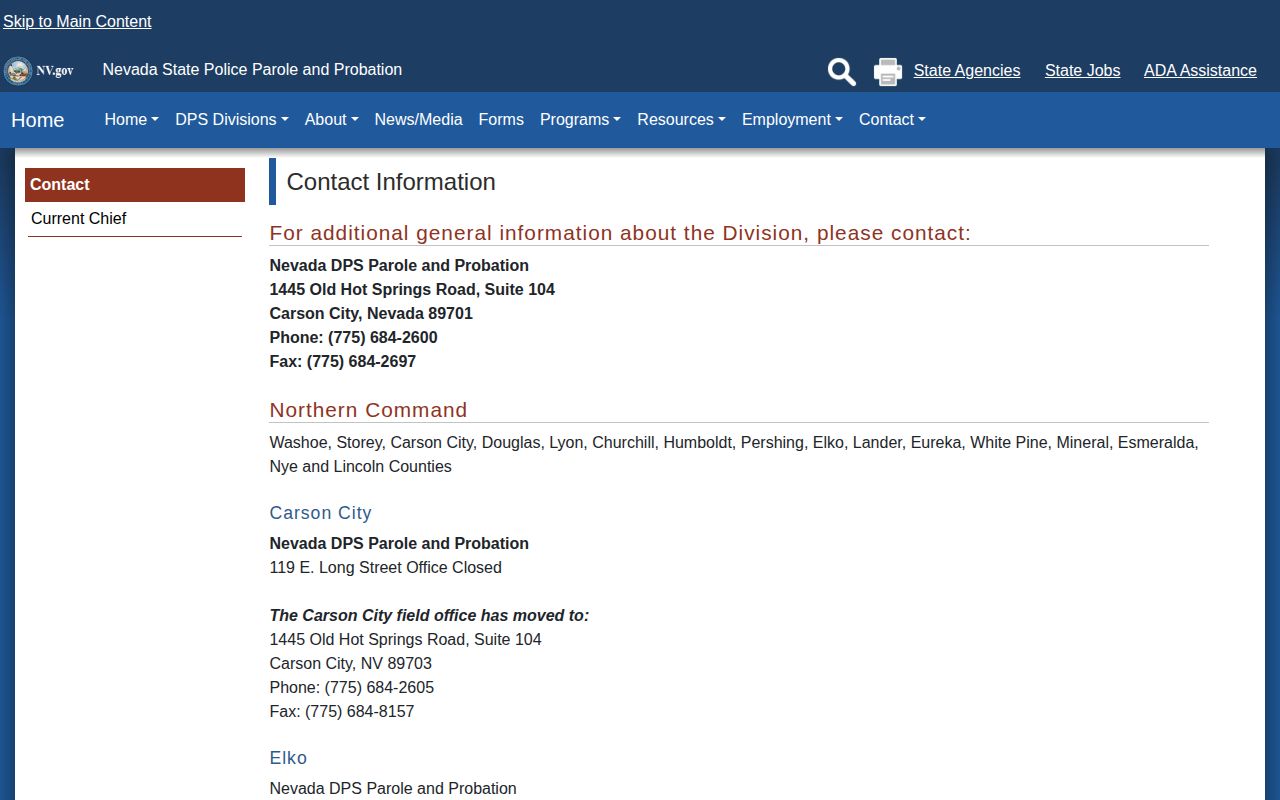
Churchill County falls within NPP's Northern Command. The official contact page routes local supervision questions through the Carson City field office rather than a public Fallon name-search counter. This is a distinctive local access point. The street address and telephone are the safest details to use because the agency page has displayed differing ZIP codes in its general and field listings. Confirm mailing details on the current page before sending records or private documents.
NPP Carson City Field Office
Nevada State Police Parole and Probation
1445 Old Hot Springs Road, Suite 104
Carson City, Nevada
Field office: (775) 684-2605
Fax: (775) 684-8157
Division line: (775) 684-2600
Official contact information
A caller should provide enough information to distinguish the person, then ask whether the office can confirm active supervision or direct the question to a records custodian. Staff may limit what they disclose by telephone. Do not infer that silence means discharge. Interstate compact supervision can also place a person in Nevada under another state's authority, or place a Nevada case under supervision elsewhere. NPP handles those cases, but the source judgment may remain important.
The official NPP contact page provides the source view shown below.
Churchill County Warrants and Absconders
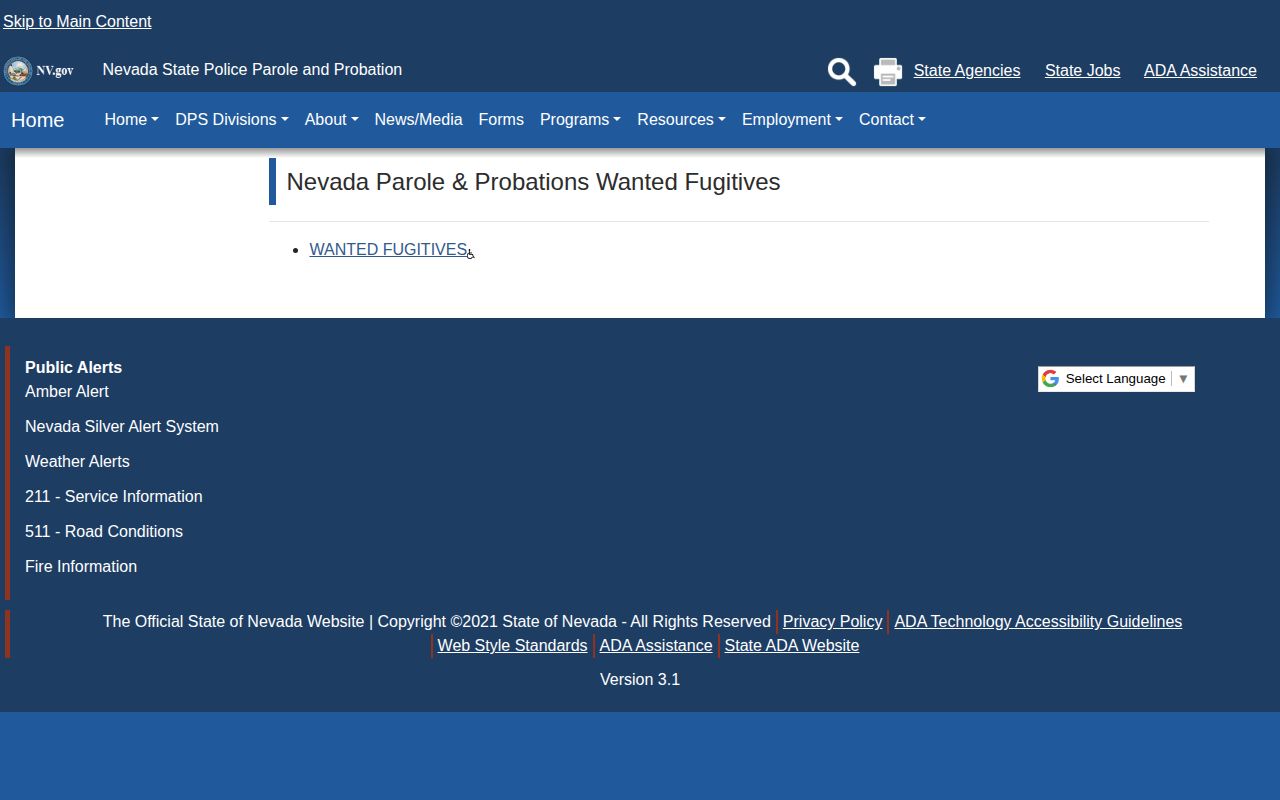
NPP maintains an official Wanted Fugitives page. It is a selected public-notice channel, not a complete list of every supervision warrant. At the research date, the agency homepage displayed “Public NOTICE: None” in that module. That statement is time-sensitive. Search engines still return old agency flyers, including documents from 2015, so an apparent wanted notice must be checked for its publication date and against the current agency page.
An absconder is generally a supervised person alleged to have stopped reporting or left supervision without permission. A current wanted entry signals an allegation and wanted status, not a new conviction. Conversely, absence from the public page does not prove compliance, discharge, or freedom from warrants. The agency may not select every warrant for public posting, and online information can change. Direct NPP confirmation is the safer route when current status matters for personal safety, notification, or a legal process.
The current NPP wanted page is the source for the captured notice view.
Common supervision conditions can include reporting, approved residence, travel limits, treatment, testing, fees, or restrictions set by a court or the Parole Board. The exact judgment, parole certificate, or supervision document controls. A reported violation can lead to investigation, a warrant, arrest, or a hearing. It does not by itself prove revocation. Residential confinement also requires care: NPP describes it as house arrest for certain parolees, probationers, and inmates, sometimes with electronic or alcohol monitoring. A person may be outside a cell while still under substantial legal restraint.
Churchill County Supervision Records
NDOC's portal is useful, but NDOC expressly warns that it contains raw data, may include errors, and is not an official record. That warning creates a clear confirmation ladder for Churchill County parole cases. Family Services can answer portal questions at (775) 977-5707. Offender Records lists omdrecords@doc.nv.gov. A written public-record request is appropriate when an official or certified release or discharge record is required. Record the exact source label, date, Offender ID, and booking ID so different episodes are not combined.
The NDOC release data may show more than one release for one person. Multiple sentences, parole episodes, returns, and later releases can create legitimate repeated events. The newest date is not automatically an unconditional discharge. Read the release description with the matching booking and sentence data. If the entry indicates parole, then use NPP and Parole Board records to determine whether supervision continued and how it ended.
- Portal question: contact NDOC Family Services.
- Release or discharge document: contact Offender Records or submit a public-record request.
- Current supervision: contact the serving NPP field office.
- Parole decision: review the Board action for the correct month.
- Probation authority: obtain the court judgment or discharge order.
How Churchill County Supervision Ends
Parole is not the same as discharge. The Board states that a parolee remains within its jurisdiction and under NPP supervision until the sentence ends or early discharge is granted. Probation ends according to the court's term and any later order. Completion should be supported by an agency or court record rather than inferred from a missing online result. A name can disappear because of spelling, data changes, record sealing, or the limits of a public interface.
Nevada's record-sealing timeline makes the distinction especially important. Under NRS 179.245, the waiting period commonly runs from release from actual custody or discharge from parole or probation, whichever occurs later. Someone who left prison but remains on parole may not yet have reached that starting point. A sealing order can later affect what public searches return. It does not rewrite the meaning of the earlier custody and supervision records.
For the complete release path, compare supervision records with the Churchill County released-inmate search and release-record process. The jail record establishes whether the local event was community release or transfer. NDOC records cover state custody and parole release. NPP and court records establish supervision and discharge. Keeping those sources separate prevents a transfer, parole placement, probation order, and final discharge from being treated as the same event.